although i've posted pictures of blocks before, this album is compiled to show various types of blocks: from thick and thin lines, relief and negative images.
 |
| i enjoy playing with borders, combining them in different ways. these vary from 1.4 to 1.7 inches wide. they are often used to separate areas with large designs, such as paisleys or birds and flowers |
 |
| i also collect whimsical blocks, just because they are unusual. this is a small block, about 3.5 inches high. i've used it quite often, as a lampshade border |
 |
| i picked up this block for a song, - and have used it over and over again, as it is or in combination with embroidery. |
 |
| this is a filigree block, about 6.5 inches high. |
 |
| one of several blocks picked up for a song. most of my antique blocks were very expensive, but this one was probably originally the carved decoration on a piece of furniture, as is the one below. i've bought several like this. the surface looks a little pitted but it prints well. i like using blocks with an irregular and/or top and bottom edge. |
 |
| as above - probably belonged on a piece of furniture from the frontier. |
 |
| floral paisley |
 |
| i use this block in combination with embroidery. i also have a square block which features a vase with a bouquet, and my block printer, whose family has practiced the craft for generations, tells me that it would have originally been used on prayer mats. |
 |
| this flower is about 5 inches across. since it's very contemporary looking i thoroughly enjoy using it. |
 |
| i bought the border a long time ago, the palm tree very recently. i noticed how well they went together just by chance when going through my blocks, which i do regularly to refresh my memory of what i have, as well as to look for new ideas or combinations |
 |
| a very small relief block, about 2.5 inches. i haven't been able to use it yet as it doesn't lend itself well to a border: the bottom doesn't print a straight line, and it's not easy to turn it over and use it upside down, which i often do with other blocks. |
 |
| an unusual block which i didn't end up buying as i didn't think i would use it in my work. |
below is an ombre dyed scarf printed with a four line block and repeats of a floral block; above it is a peacock block. this is actually a three-part block, each part being used to print a different colour, ending with the outline. i use these two independently; the third block, not shown here, is not a complete bird but only features fine details to be picked out in colour.
 |
the peacock on the left is the filler block
while the one on the right is the outline. the outline is printed last. |
below are examples of ajrak blocks.
 |
| this block measures about 5.5 inches square |

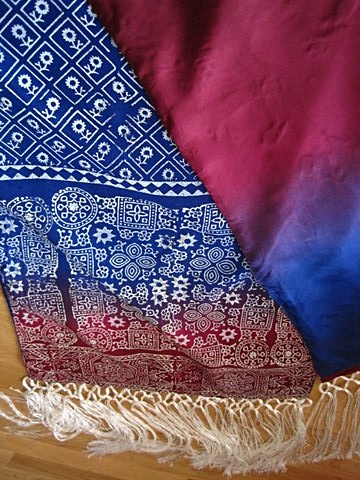
the silk scarf below is ombre-dyed in blue and red and overprinted in white. if you look closely you will see the first of the two ajrak blocks shown above. this is not the way traditional ajraks are made, but is my own take on using the blocks, of which i have collected several.
the black and white photograph below shows my block printer (karegar, or artisan) printing the design. real ajrak making involves resist block printing. the designs are printed with a resist that will not take the traditional indigo or alizarin shades, and will eventually wash out leaving the printed area white.

click on the link for an article on ajrak and a slideshow, which shows how in this process the design is printed using a resist:


